
28/06/2025
Resilience through innovation: Europe's clean tech ecosystem gains ground
Ukraine’s reconstruction needs remain immense, with recovery costs estimated at more than €500 billion over the coming decade. While national funding and international support are essential, many of the most important rebuilding decisions are being made locally, by municipalities, schools, and community leaders determined to shape a more sustainable future.
For many communities, reconstruction is about more than replacing what was lost. It is an opportunity to modernise outdated infrastructure, improve public services, and create healthier, more climate-friendly places to live. Yet local authorities are often understaffed and face the challenge of navigating complex recovery processes with limited resources and experience.
Our initiative helps communities build the capacity to lead this transformation. We support local leaders through training, strategic planning, peer learning, and community engagement, while helping municipalities access and effectively use available funding.
As a result of our work:
Communities Shaping Their Own Future
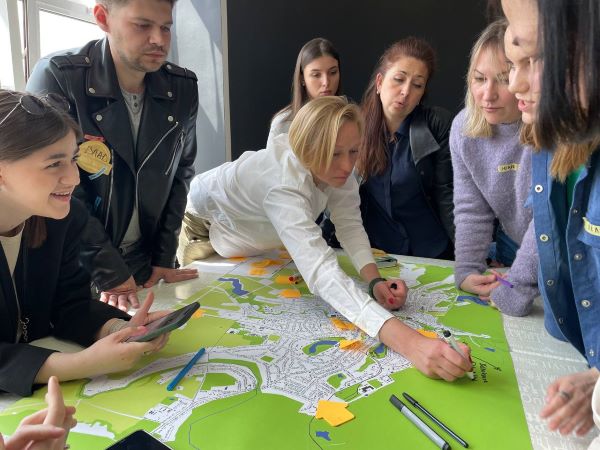
Our partner Urban Reform has been supporting municipalities across Ukraine to develop shared visions for recovery and long-term development. These processes bring together local government, businesses, civil society organisations, and residents to identify priorities and build local ownership.
In Okhtyrka, a community-led visioning process became the foundation for the municipality’s development strategy. The initiative also helped unite local government, businesses, and civil society around plans to revitalize abandoned industrial areas in the city centre.
In Shostka, residents identified the embankment as a key public space and highlighted the importance of bringing nature back into the city. The idea gained traction, leading local authorities to begin clearing and improving the area as a development priority.
In Oleksandria, a workshop on creating temporary public spaces inspired residents to become directly involved in improving their city. Community members organised themselves to transform local spaces, while the municipality moved forward with plans for a new tourist route.
These examples demonstrate that sustainable reconstruction is not only about infrastructure and investment. It is about empowering people to participate in decisions, take ownership of change, and turn ideas into action.
A Collaborative Effort
Our partners in Ukraine work closely together bringing unexpected synergies. Environmentalists bring elements of nature protection into urban areas; urbanists help communities to see economic benefits of sustainable solutions; organizations specialized in renewable energy give advice on how to integrate it into city planning; former mining communities share their experience of transformations with their peers and so on.
This multi-faceted approach helps our partners to bring feedback both to national decision-makers and the EU on how to improve the mechanisms of support to make them most efficient.