
28/06/2025
Resilience through innovation: Europe's clean tech ecosystem gains ground
A new documentary from the Czech project CzeXperiment, supported by the European Climate Foundation (ECF), demonstrates how structured public dialogue can help bridge deep societal divides, and inspire concrete civic action.
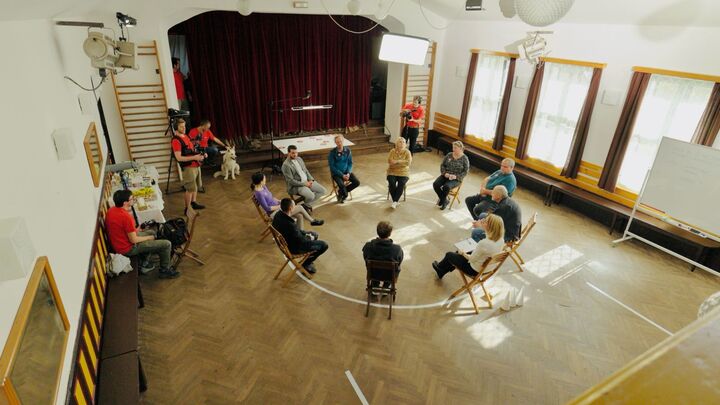
The first film in a three-part series, premiering online on 10 June 2026, focuses on one of the most polarising issues in Czech society: whether and how to support Ukraine. The format brings together nine participants with opposing views: four in favour, four against, and one undecided, in a facilitated discussion.
The results were striking. Despite initial disagreement, participants were able to move towards consensus, ultimately producing a joint recommendation for further support of Ukraine that was presented to the President of the Senate of the Parliament of the Czech Republic, Miloš Vystrčil.
A key turning point came when participants recognised a shared emotional ground. While their political positions differed, many expressed a common fear of war. This moment of mutual recognition helped shift the discussion from confrontation to cooperation, allowing participants to connect, empathise and work towards shared solutions.
The impact extended beyond the discussion itself. One participant launched a new civic initiative in her hometown, SLUDOČ (“decently, face to face”), highlighting the wider ripple effects of participatory experiences. Previous CzeXperiment formats have similarly led to real-world outcomes, from community initiatives to policy-relevant discussions and public awareness campaigns.
CzeXperiment uses social experiments and storytelling to engage large audiences in complex societal issues. To date, the project has reached over 5.8 million viewers on YouTube, with an audience that is predominantly under 35. Its mission is to counter polarisation by making participation visible, relatable and emotionally engaging.
This work is a joint effort by the European Climate Foundation (ECF), Blíž k sobě Foundation, and Kladné nuly foundation, which focuses on highlighting the role of citizen participation in addressing major challenges such as climate change and energy security. As part of this collaboration, three “neighbours’ gatherings” are being filmed in rural Czech communities. The goal was to capture how everyday conversations can be held in familiar settings such as pubs or community spaces and lead to more inclusive and constructive public debate.
Two further films in the series will explore topics including the “Villagers’ Green Deal” and education reform. Early indications suggest that similar facilitated discussions helped participants reach shared positions even on these contentious issues.
These experiments demonstrate that when people are given the right conditions like safe spaces, skilled facilitation and time to listen to each other’s concerns, our public debates can become more constructive, inclusive and solution-oriented.
Looking ahead, ECF and its partners aim to build on this momentum by expanding facilitator training, supporting participatory formats across regions, and contributing to the long-term ambition of establishing a national Citizens’ Assembly in Czechia.